Semantic signals are estimated across channels rather than forced into one brittle partition.
Semantic watermarking · ICLR 2026
PMark
Robust and distortion-free semantic-level watermarking through channel constraints.
1 The Hong Kong University of Science and Technology (Guangzhou) · 2 The Hong Kong University of Science and Technology · 3 Peking University · 4 National University of Singapore · 5 Tsinghua University
Project overview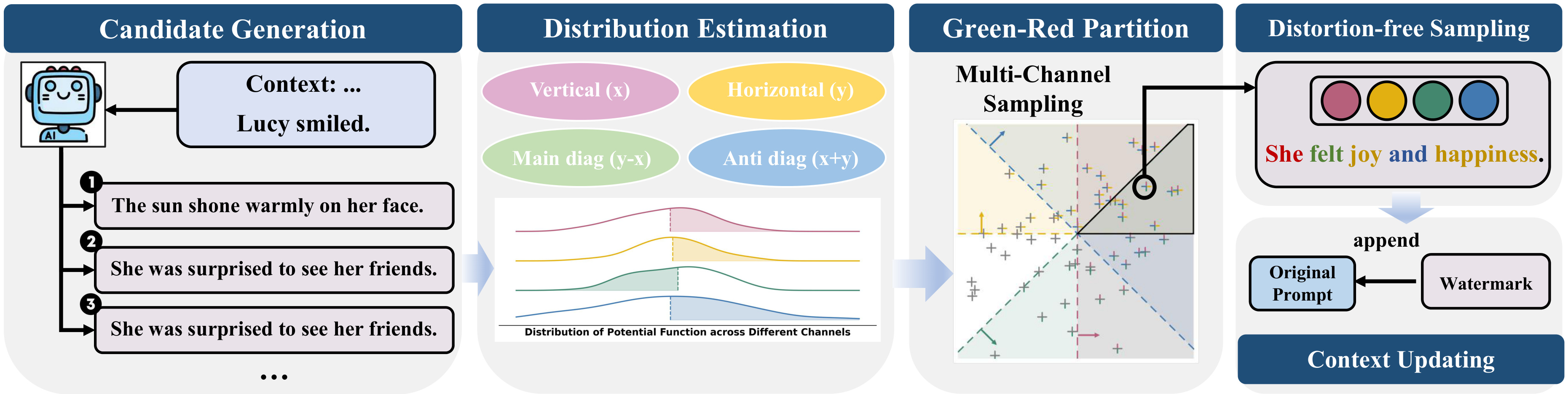
PMark estimates semantic channels and constrains their joint sampling process to keep the watermark robust and distortion-free.
Motivation
Robustness and distributional fidelity should be optimized jointly.
Semantic watermarking must introduce detectable structure without changing the language model distribution that determines generation quality.
Conventional text watermarks bias next-token probabilities toward a key-dependent subset of the vocabulary. Although effective for detection, this intervention alters the original model distribution and may reduce fluency or become fragile under semantic-preserving edits. Semantic-level methods improve robustness, but their sampling procedures can still introduce uncontrolled distributional distortion.
PMark formulates the problem through semantic channels: a watermark is encoded by coupling channel assignments while preserving the marginal distribution of the language model. This perspective provides an explicit criterion for distortion-free generation rather than treating quality preservation as an empirical side effect.
Contributions
Methodological properties
Constrained sampling preserves the model’s intended token distribution during generation.
Channel-level structure gives the watermark a stable signal under common text transformations.
Methodology
Constrained sampling over semantic channels
The generation procedure separates semantic representation, watermark assignment, and distribution-preserving sampling.
Candidate construction
At each generation step, PMark obtains candidate continuations from the base language model and embeds them in semantic space. The candidate probabilities retain the model's native likelihoods and form the empirical distribution to be preserved.
Channel estimation and partitioning
The method estimates multiple semantic channel distributions and assigns regions to key-dependent green and red sets. Channel constraints regulate the partition so that watermark-compatible mass remains statistically balanced.
Distortion-free sampling
PMark jointly samples across constrained channels and updates the context state after each selection. The coupling carries a detectable semantic signal while preserving the original marginal token distribution used by the language model.
Visual results
Method analysis and experimental results
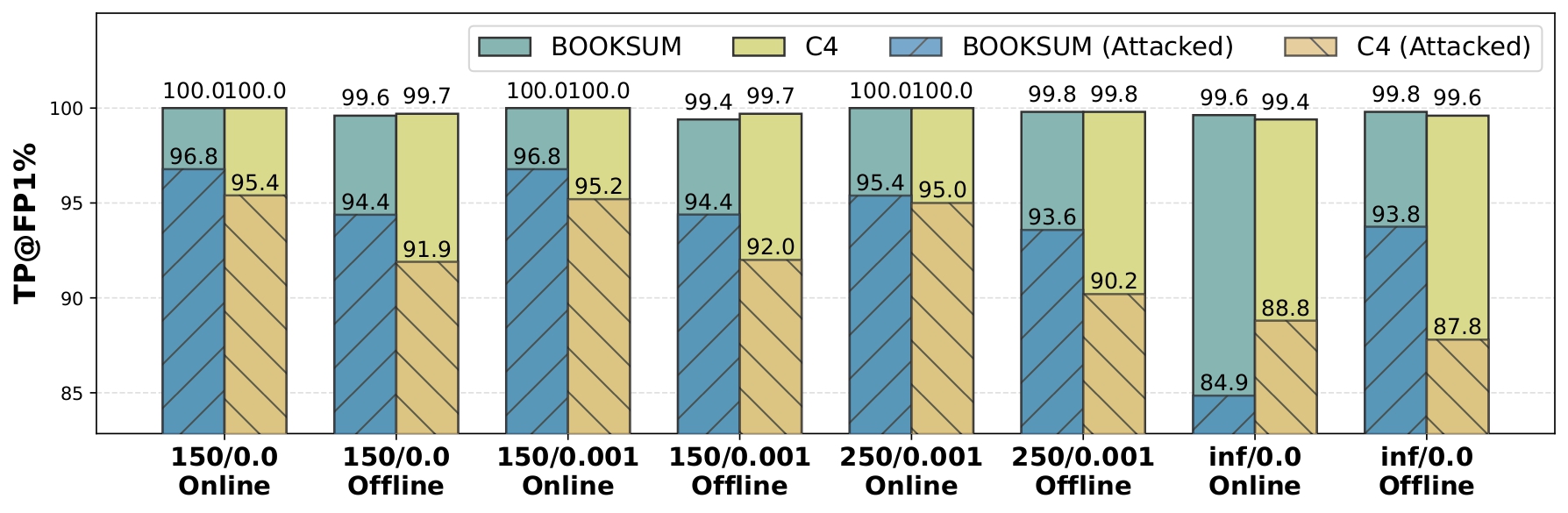
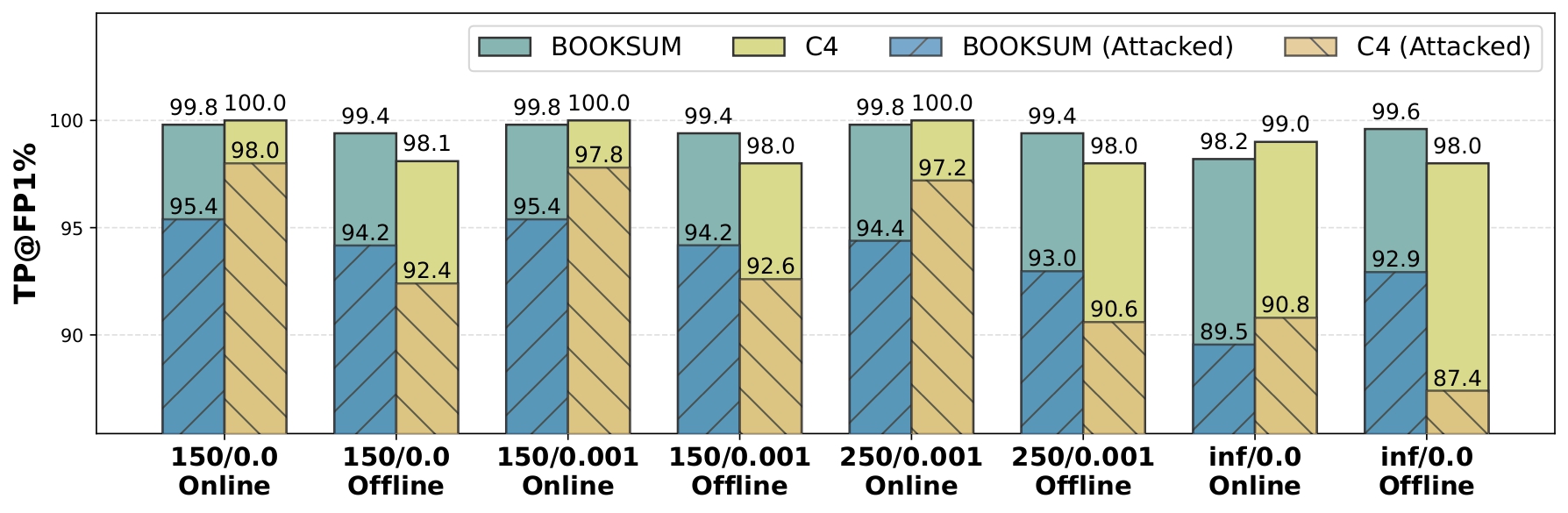
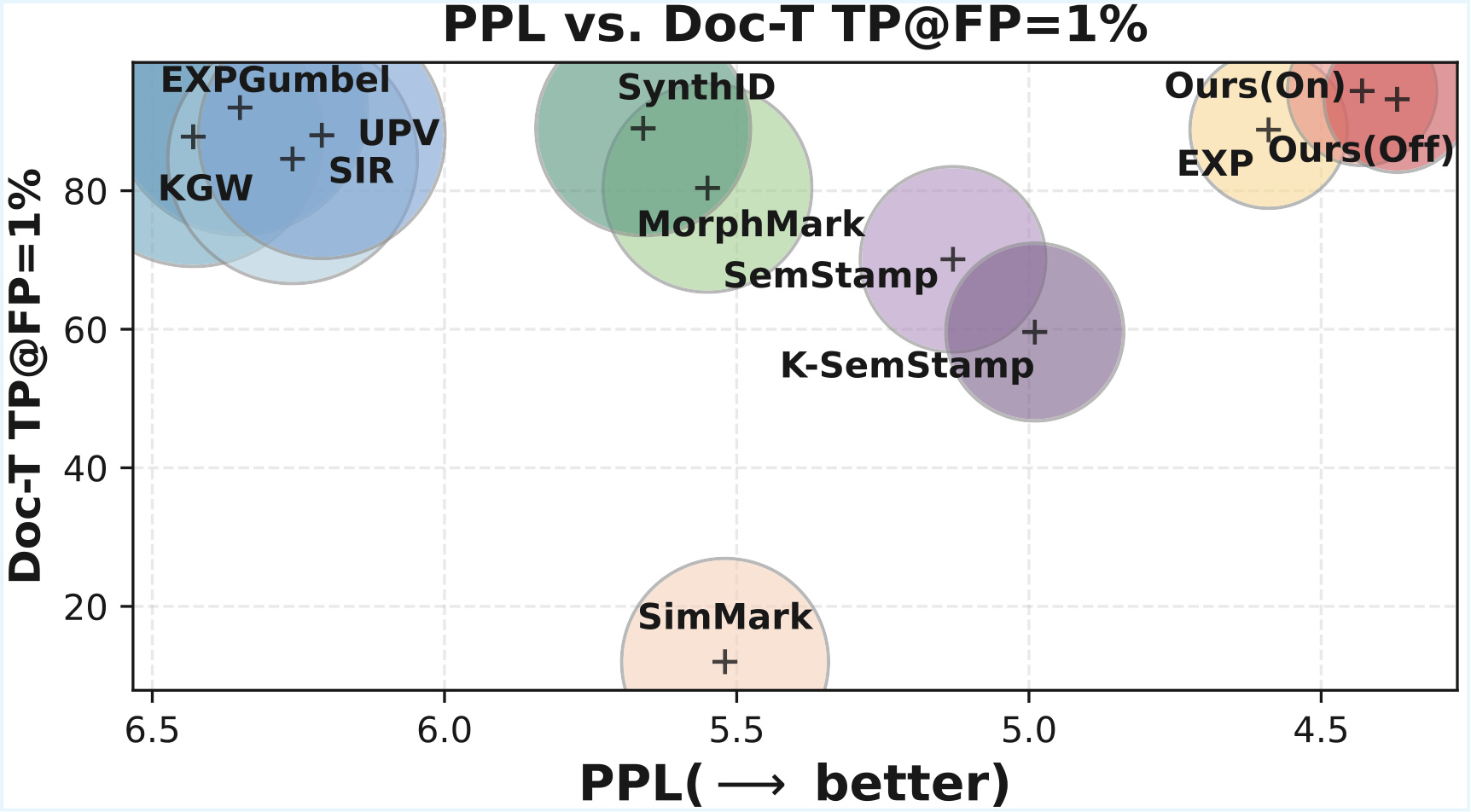
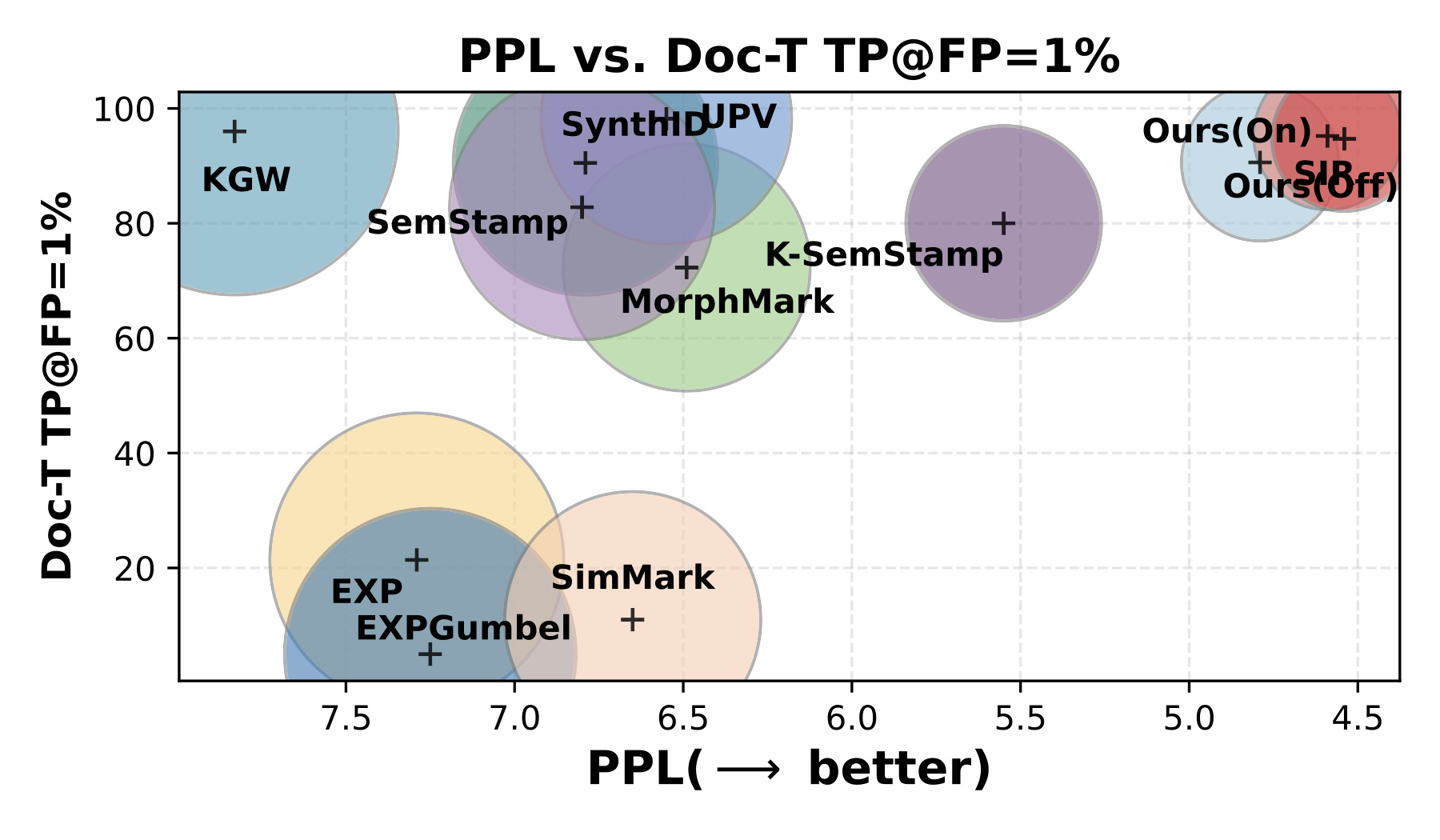
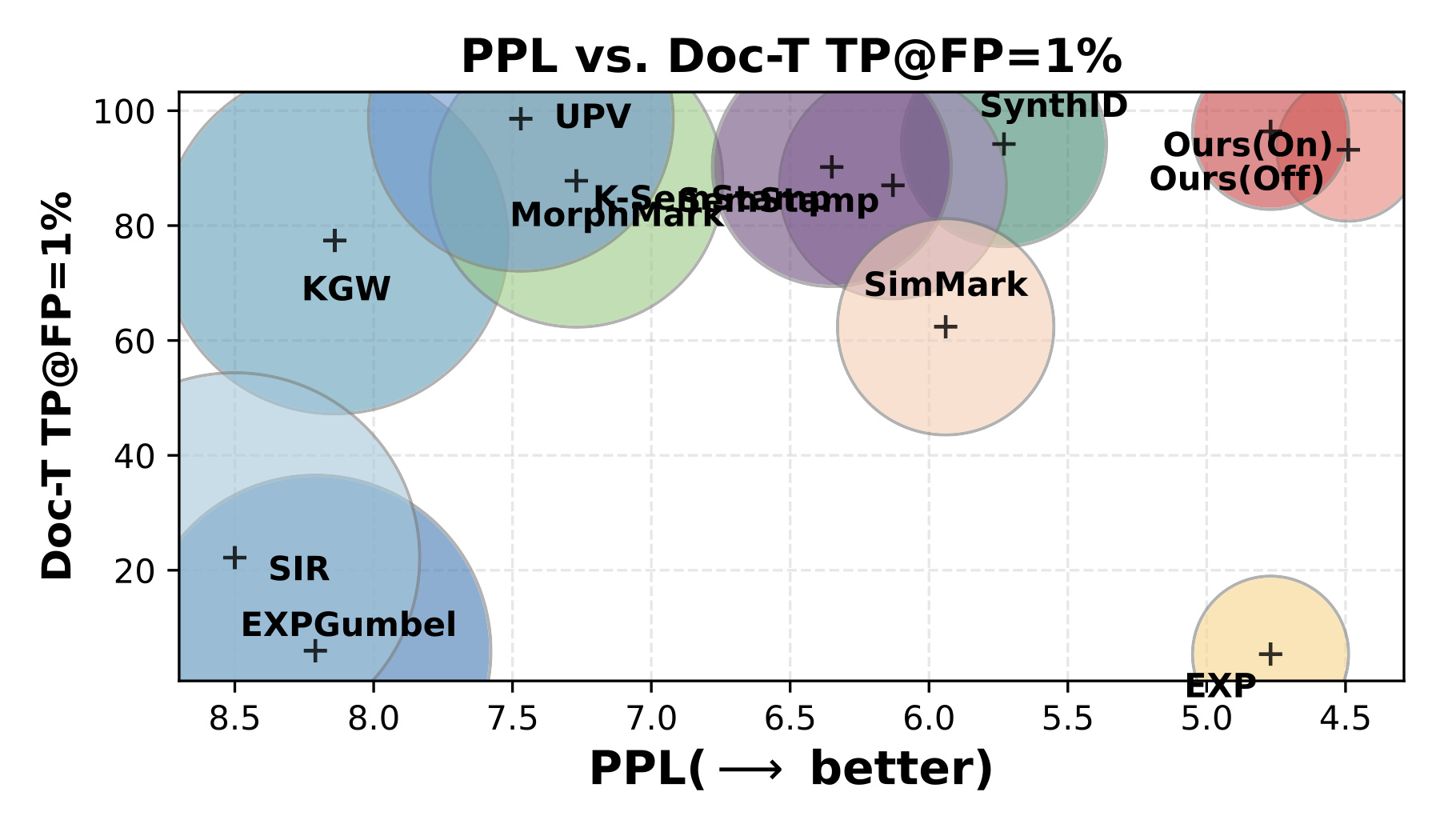
The method and analysis figures connect the channel view to robustness and quality comparisons.
Citation
BibTeX
@article{huo2025pmark,
  title   = {PMark: Towards Robust and Distortion-Free Semantic-Level Watermarking with Channel Constraints},
  author  = {Huo, Jiahao and Liu, Shuliang and Wang, Bin and Zhang, Junyan and Yan, Yibo and Liu, Aiwei and Hu, Xuming and Zhou, Mingxun},
  journal = {arXiv preprint arXiv:2509.21057},
  year    = {2025}
}