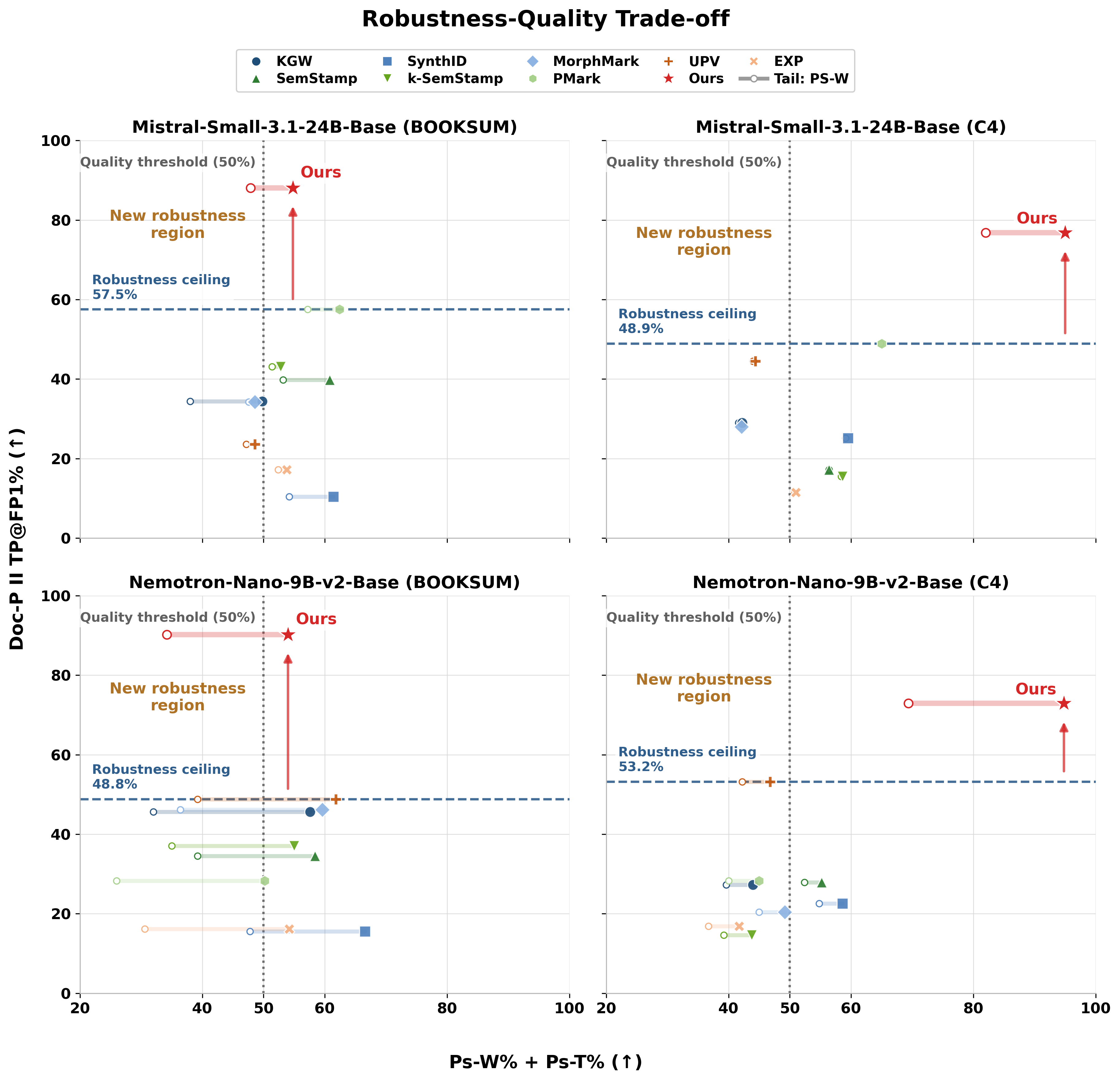
Reported TP@FP1% under representative paragraph-level paraphrase attacks.
Text watermarking · 2026
SAMark
A self-anchored semantic watermark built to survive paragraph-level paraphrasing.
1 The Hong Kong University of Science and Technology · 2 The Hong Kong University of Science and Technology (Guangzhou) · 3 University of Illinois Chicago · 4 National University of Singapore
Project overview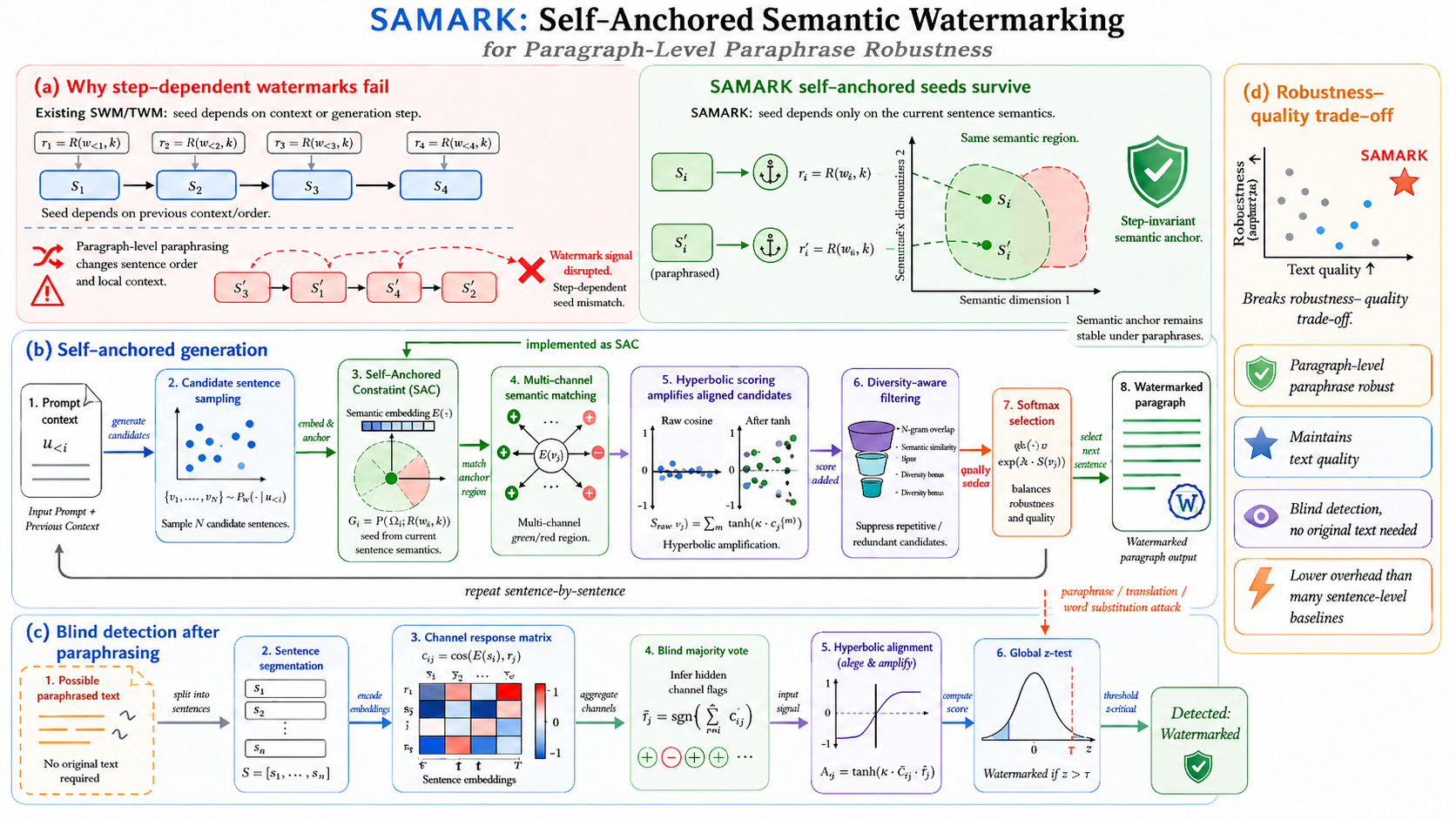
SAMark combines self-anchored semantic regions, multi-channel scoring, and diversity-aware filtering.
Motivation
Robust watermarking requires a stable semantic reference.
The central challenge is to preserve detectability after substantial rewriting while maintaining the fluency and semantic diversity of generated text.
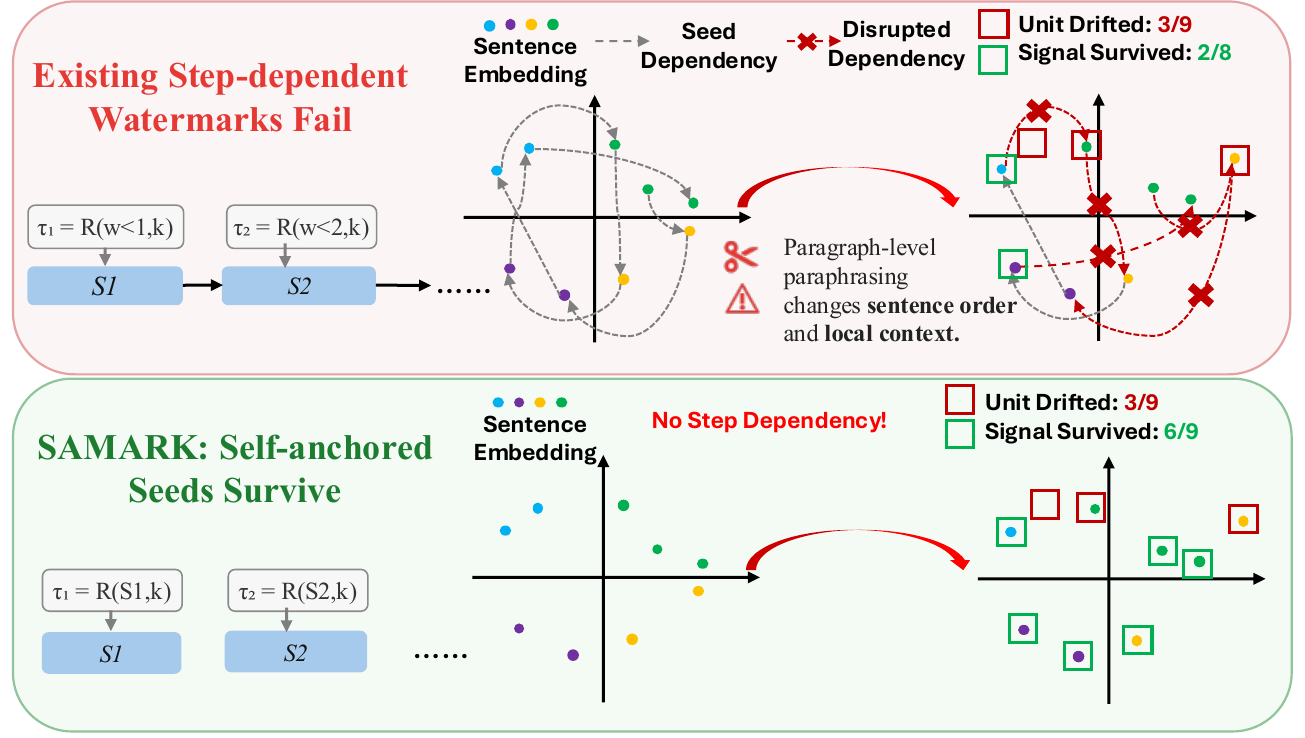
Most token-level watermarks encode signals through local vocabulary perturbations; these signals can be weakened by paraphrasing. Existing semantic alternatives improve invariance, but often rely on sequentially propagated states or partitions tied to preceding sentences. Paragraph reordering, insertion, or deletion can therefore desynchronize generation and detection.
SAMark addresses this dependency by deriving the watermark reference from each sentence itself. This self-anchored formulation makes the detection unit locally reproducible and motivates a semantic signal that is both paraphrase-resistant and independent of global sentence order.
Main findings
Empirical results
Average gain over the strongest baseline in the reported robustness comparison.
Multi-channel semantic scoring gives the detector more stable evidence to aggregate.
Methodology
Self-anchored semantic watermarking
SAMark constructs and verifies the watermark at the sentence level through three coordinated components.
Self-anchored region construction
For each generated sentence, SAMark computes a semantic anchor from the sentence context and uses it to define a reproducible watermark region. Because the anchor is local, detection does not require recovering the original sentence sequence.
Multi-channel hyperbolic scoring
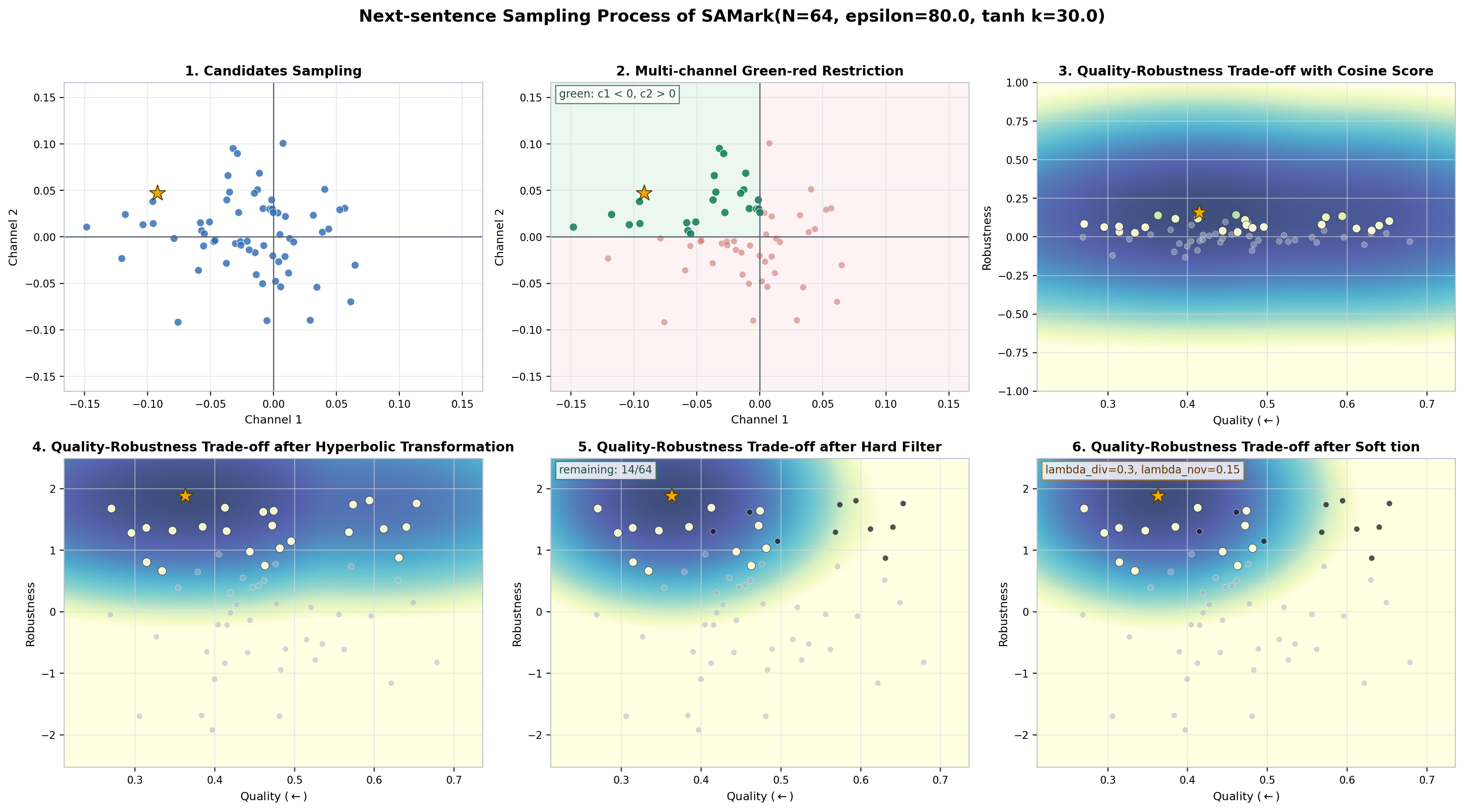
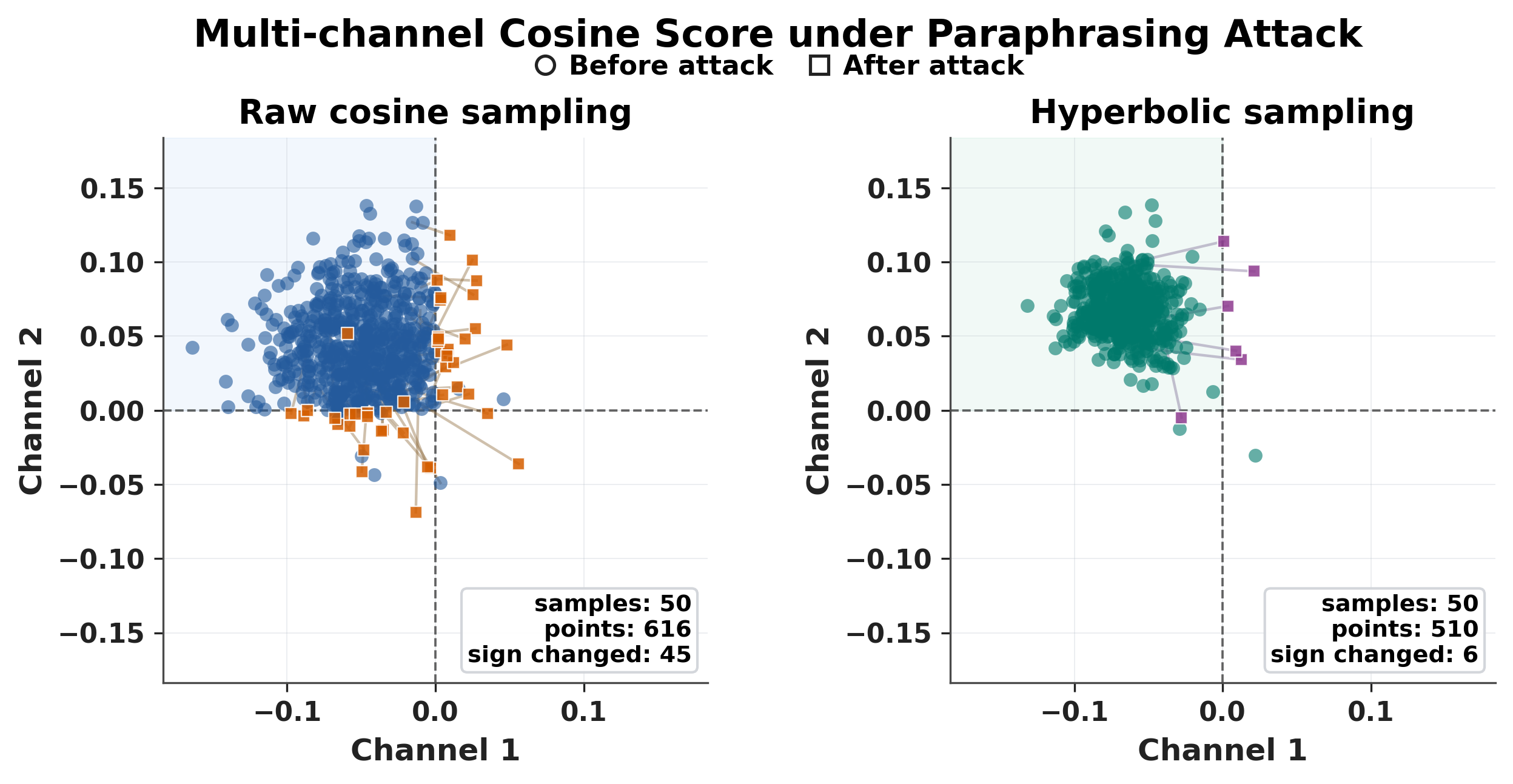
Candidate sentences are represented in hyperbolic semantic space and evaluated through complementary channels. Their aggregated scores determine whether a candidate lies in the designated region and strengthen the statistical evidence available to the detector.
Diversity-aware generation and detection
A diversity-aware filter removes semantically redundant or low-quality candidates before sampling. At inference time, sentence-level scores are recomputed and aggregated into a document-level hypothesis test for watermark detection.
Visual results
Method analysis and experimental results
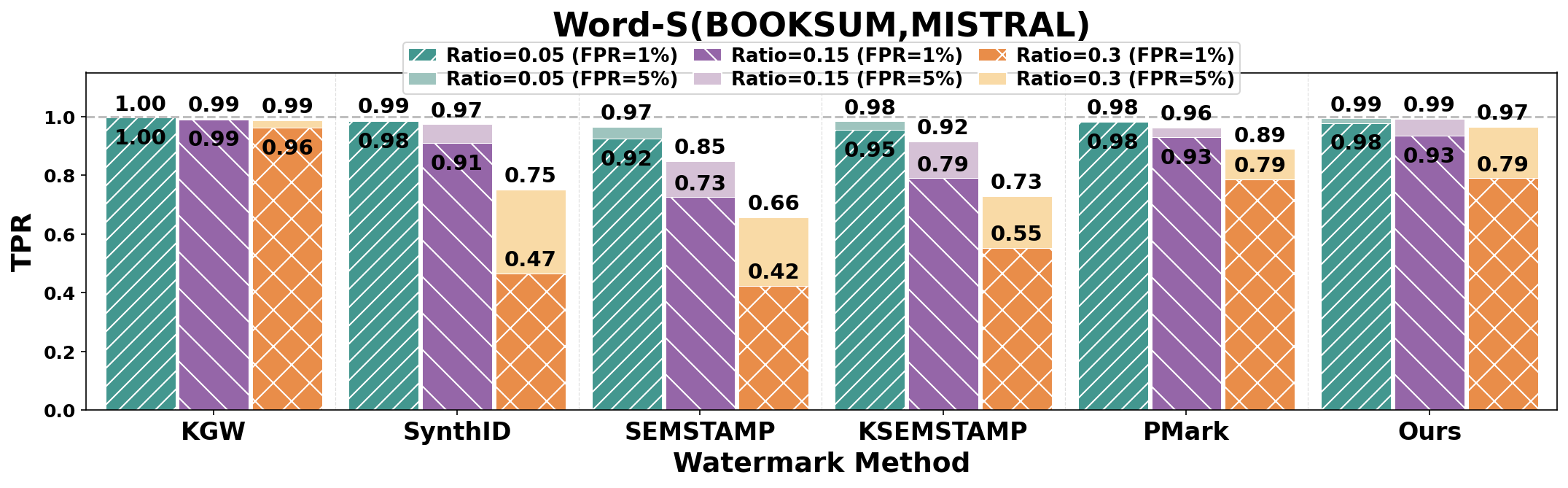
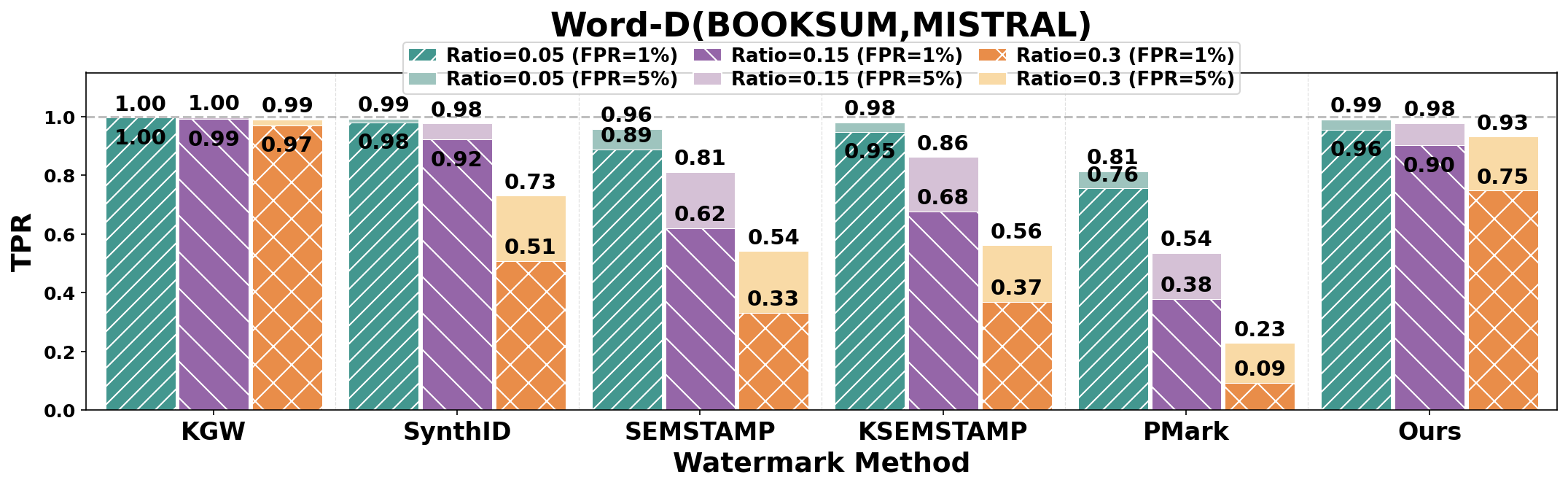
The figures below show the design intuition, robustness frontier, and behavior under word-level attacks.
Citation
BibTeX
@article{huo2026samark,
  title   = {SAMark: A Self-Anchored Text Watermarking with Paragraph-Level Paraphrase Robustness},
  author  = {Huo, Jiahao and Qu, Wenjie and Yan, Yibo and Zheng, Kening and Zhang, Jiaheng and Hu, Xuming and Yu, Philip S. and Zhou, Mingxun},
  journal = {arXiv preprint arXiv:2605.25796},
  year    = {2026}
}